

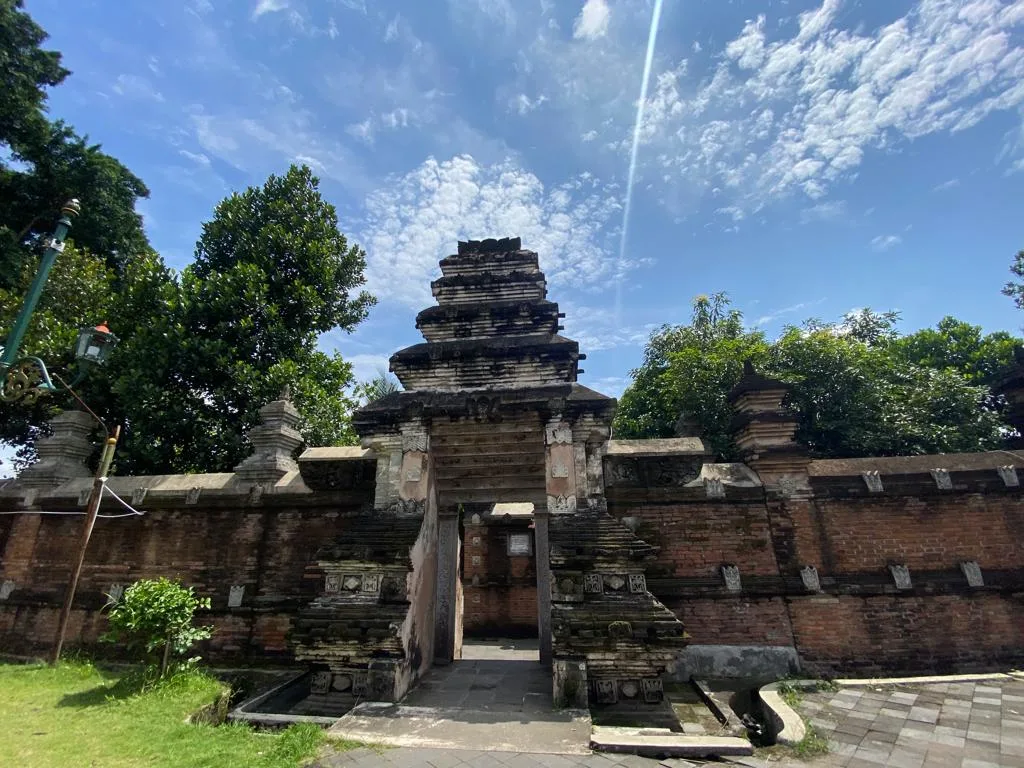
In Central Java, there was once a prosperous Islamic kingdom known as the Mataram Kingdom. Emerging in the late 16th century in Kotagede, Mataram eventually grew into one of the most powerful political forces in Java, with its royal center subsequently moving from Kotagede to Kerta, Plered, Kartasura, and lastly Surakarta.
Table of Contents
In the 18th century, however, the kingdom was divided into Kasunanan Surakarta and Kasultanan Yogyakarta. This separation gave rise to distinct traditions and cultural heritage within the two royal courts, many of which can still be explored today.
Where Did the Mataram Kingdom Come From?
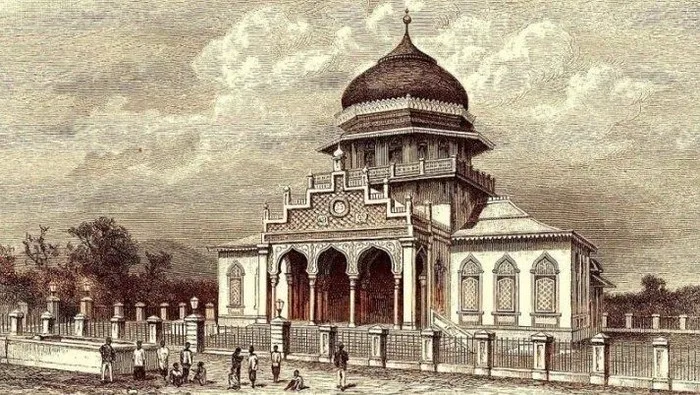
The origins of Mataram Islam can be traced to Ki Ageng Pemanahan, the father of the kingdom’s first king, Panembahan Senopati. According to Javanese historical traditions, Pemanahan and his son were involved in the resistance against Arya Penangsang, a rival to Jaka Tingkir, who later became known as Sultan Hadiwijaya.
Following the resistance, Sultan Hadiwijaya then established the Sultanate of Pajang and granted Ki Ageng Pemanahan a large forested area known as Alas Menatok. The settlement that developed in this area later became Kotagede, which served as the early center of Mataram.
After Ki Ageng Pemanahan died in 1584, his son, Panembahan Senopati, succeeded him as the ruler of Mataram. As Pajang’s political authority weakened, Senopati expanded Mataram’s influence and established it as an independent Islamic kingdom in 1586.
This history specifically concerns Mataram Islam rather than the Ancient Mataram Kingdom, also known as Medang Kingdom.
From Panembahan Senopati to Sultan Agung: The Rise of Mataram
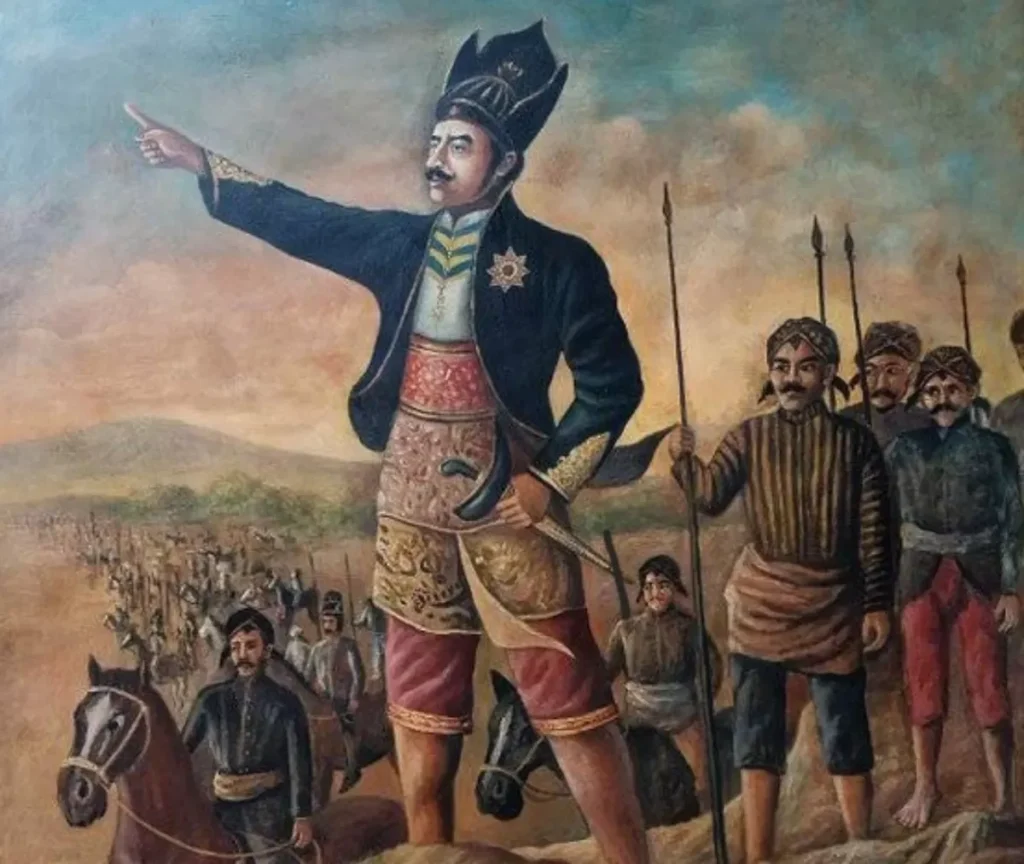
Mataram’s early expansion can be simplified through several important rulers. Ki Ageng Pemanahan pioneered the development of the region that would later become the precursor to Mataram Islam. He was followed by his son Panembahan Senopati (1586 – 1601), who established Mataram Islam and became its first ruler.
His successor was Panembahan Hanyakrawati (1601 – 1613), the first king of Mataram to develop foreign policy. Finally, under Sultan Agung Hanyakrakusuma (1613 – 1645), Mataram reached its greatest territorial and political expansion in the first half of the 17th century.
Sultan Agung and the Expansion of Mataram
Sultan Agung ascended the throne in 1613 and ruled until 1645. During his reign, he pursued the expansion of Mataram’s political authority across Java, including efforts to bring areas outside the kingdom’s immediate territory under its control. His objectives also included challenging the growing influence of the Dutch East India Company (VOC), particularly its position in Batavia.
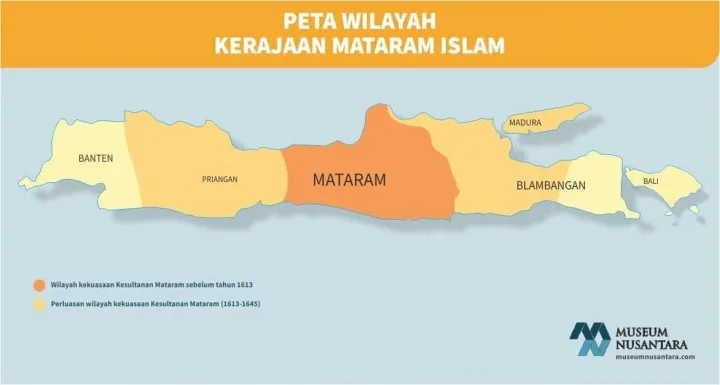
By the 1620s, Mataram had expanded its territory considerably, including into several important areas along Java’s northern and eastern coasts. The expansion strengthened the kingdom’s political and military position while also increasing its influence over trade and regional affairs.
Mataram vs VOC: The Struggle for Java
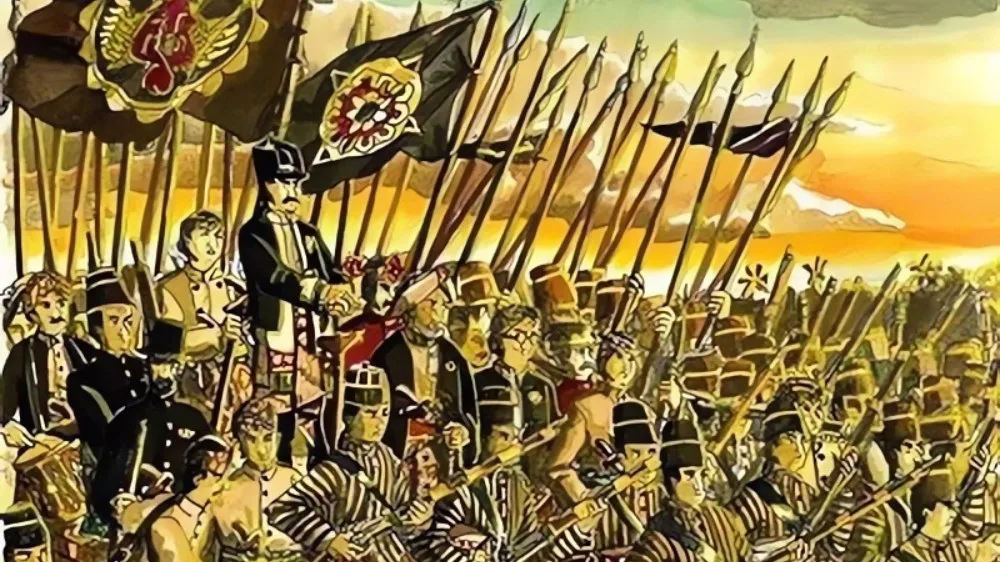
Mataram’s growing power eventually brought it into direct conflict with the Dutch East India Company (VOC), particularly over Batavia. Sultan Agung viewed the VOC’s presence in Batavia as a challenge to Mataram’s influence over Java.
At that time, Mataram’s territory included almost the entire Java, while VOC already had a strong position in Batavia and surrounding areas. In 1628 and 1629, Mataram launched two major military expeditions against Batavia. Both campaigns ultimately failed after VOC bombarded the food supply depots of the Mataram Islam forces.
Why Did Mataram Decline and Eventually Split?

Mataram’s decline cannot be attributed to a single event. Instead, a combination of internal conflicts, succession disputes, rebellions, and increasing outside intervention gradually weakened the kingdom’s political authority.
During the 18th century, disputes within the royal family became increasingly intertwined with VOC intervention. Rival claims to political authority and conflicts between members of the royal elite gave the VOC greater opportunities to influence Mataram’s affairs.
The major turning point came with the 1755 Treaty of Giyanti, which divided the kingdom into two main royal authorities: Kasunanan Surakarta and Kasultanan Yogyakarta.
Was Mataram Related to Majapahit?
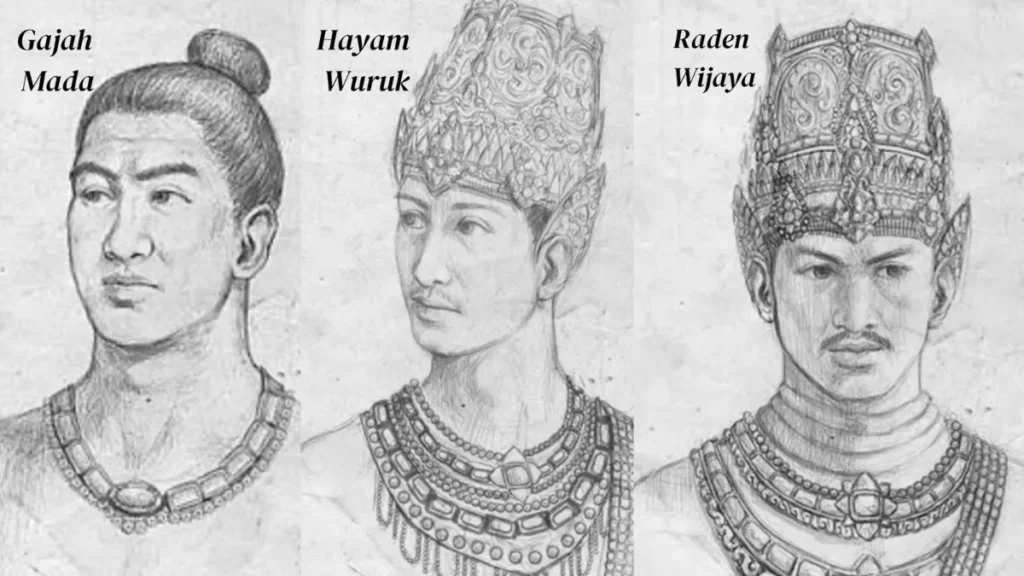
The relationship between Mataram Islam and Majapahit is interpreted differently depending on the source. Historical evidence does not establish Mataram Islam as a direct political continuation of the Majapahit Kingdom. However, Javanese royal traditions and genealogical narratives connected the rulers of Mataram with the former Majapahit royal lineage.
One example can be found in Babad Tanah Jawi, which traces the lineage of Ki Ageng Pemanahan through his father, Ki Ageng Henis, to Brawijaya V, traditionally regarded as the last king of Majapahit.
The Legacy of Mataram in Java Today

Mataram Islam’s history didn’t disappear after the kingdom was divided. Its political and cultural legacy remains through several royal houses across Central Java and Yogyakarta.
The Kasunanan Surakarta remains one of the most important royal institutions in Solo, while the Mangkunegaran developed as an autonomous princely house within the wider political landscape of Surakarta. In Yogyakarta, the Kasultanan Yogyakarta remains closely connected to the region’s history and cultural identity, while the Pakualaman functions as another autonomous princely house.
These institutions continue to preserve aspects of Mataram’s cultural legacy through traditional arts, ceremonies, daily practices, and historic landmarks. Examples include Serimpi Dance in the Yogyakarta court tradition, Gambyong Dance associated with Surakarta, and the royal cemetery complex in Kotagede, where members of the early Mataram royal family are buried.
Mataram Kings and Royal Lineage
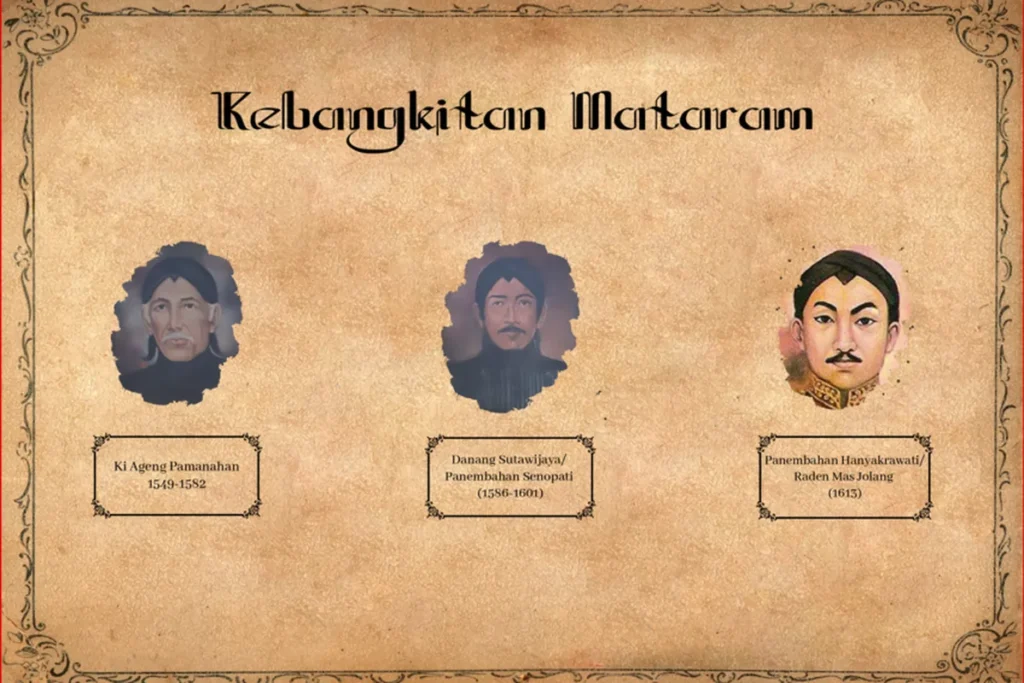
Ki Ageng Pemanahan
↓
Panembahan Senopati (1586–1601)
↓
Panembahan Hanyakrawati (1601–1613)
↓
Sultan Agung Hanyakrakusuma (1613–1645)
↓
Amangkurat I (1645–1677)
↓
Amangkurat II (1677–1703)
↓
Later Mataram rulers → Pakubuwono II → Surakarta
It’s important to note that this simplified line doesn’t represent the entire royal genealogy. Mataram’s succession involved numerous princes, royal marriages, rival claims, and political conflicts.
Frequently Asked Questions
Who was the last king of Mataram Islam?
Pakubuwono III was the ruler of Mataram when the Treaty of Giyanti was signed in 1755. The agreement divided the kingdom between Kasunanan Surakarta under Pakubuwono III and the newly established Sultanate of Yogyakarta under Prince Mangkubumi, who became Sultan Hamengku Buwono I.
Whose lineage did the kings of Mataram Islam come from?
The royal lineage of Mataram Islam began with Ki Ageng Pemanahan and continued through his son, Panembahan Senopati, the founder and first ruler of the Mataram Sultanate.
What’s the difference between Mataram Kuno and Mataram Islam?
Mataram Kuno and Mataram Islam were two different kingdoms that existed in Java at different periods.
Mataram Kuno, also known as the Ancient Mataram Kingdom and Medang Kingdom, flourished mainly between the 8th and 10th centuries and was associated with Hindu and Buddhist dynasties.
Mataram Islam emerged in the late 16th century as an Islamic kingdom based in Central Java.
Understanding Mataram helps explain why Yogyakarta and Surakarta share such deep historical and cultural connections, almost seemingly similar. Although the kingdom was divided more than two centuries ago, its influence can still be traced through royal courts, traditional arts, historic sites, and the living culture of Java.
If you’re inspired to discover more about this legacy, explore our guides to Keraton Yogyakarta, Kasunanan Surakarta, Kotagede, and Pura Mangkunegaran.